Guides
Kansas and Missouri Chiropractic Billing: BCBS and Medicare Compared
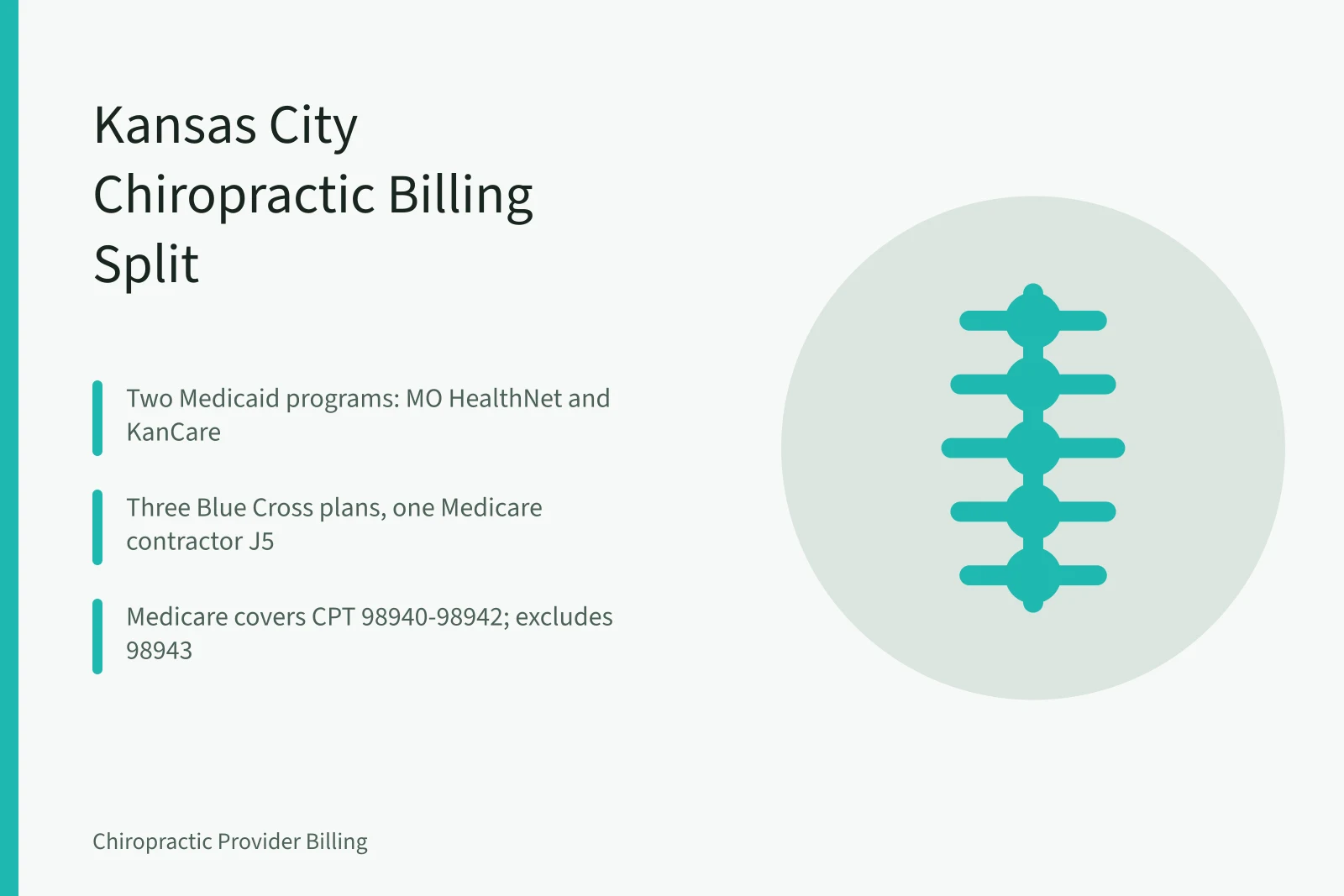
Kansas City chiropractors bill two Medicaid programs, three Blue Cross plans, and one Medicare contractor. A guide to the split, plus a British Columbia contrast.
What to take away
- Kansas City chiropractors bill two Medicaid programs, several Blue Cross plans, and one shared Medicare contractor, so the same service can be paid or denied based on the patient's address.
- Medicare covers manual manipulation of the spine to correct a subluxation, billed with CPT 98940 through 98942. Maintenance therapy, x-rays, and 98943 are excluded.
- MO HealthNet and KanCare publish separate chiropractic rules, and managed care plans can add prior authorization on top.
- British Columbia splits one visit between a provincial plan and a crash insurer, a useful contrast for single payer billing.
One metro, two insurance systems
Kansas City sits on the Kansas and Missouri line. A practice near State Line Road can treat patients from both states in one afternoon.
Kansas City payer split
Kansas
- Medicaid
- KanCare
- Blue Cross
- BCBS Kansas
- Medicare
- J5 MAC
- Prompt pay rules
- Kansas
Missouri
- Medicaid
- MO HealthNet
- Blue Cross
- Anthem BCBS
- Medicare
- J5 MAC
- Prompt pay rules
- Missouri
Both states
- Medicaid
- —
- Blue Cross
- Blue KC
- Medicare
- J5 MAC
- Prompt pay rules
- —
Each state runs its own Medicaid program, its own insurance department, and its own prompt pay rules. Nothing in the chart changes. Almost everything in the payer changes.
The metro's Blue Cross market splits three ways. Blue Cross and Blue Shield of Kansas City sells on both sides of the line. Kansas members often carry Blue Cross and Blue Shield of Kansas. Missouri members often carry Anthem Blue Cross and Blue Shield.
Three plans, one set of CPT codes.
Blue KC and the two statewide Blue plans
Check the chiropractic medical policy for each plan before the first appointment. Prior authorization triggers, visit maximums, and required modifiers differ between them.
First check per payer
- Blue KCmedical policy and prior auth list
- BCBS Kansasvisit limits and modifier rules
- Anthem BCBScredentialing status and fee schedule
- KanCareMCO prior authorization rules
- MO HealthNeteligibility group and covered codes
- Medicare Part Bsubluxation documentation and ABN use
A frequent error is copying one patient's benefit summary into the next patient's record. The codes look identical. The policy language does not, and the denial arrives six weeks later.
Keep a one page policy sheet per plan and update it when the plan posts a new bulletin.
| Payer | Where it applies | First thing to check |
|---|---|---|
| Blue Cross and Blue Shield of Kansas City | KC metro, both states | Plan medical policy and prior auth list |
| Blue Cross and Blue Shield of Kansas | Kansas statewide | Visit limits and modifier rules |
| Anthem Blue Cross and Blue Shield | Missouri statewide | Credentialing status and fee schedule |
| KanCare managed care | Kansas | MCO prior authorization rules |
| MO HealthNet | Missouri | Eligibility group and covered codes |
| Medicare Part B | Both states | Subluxation documentation and ABN use |
Missouri Medicaid and KanCare chiropractic coverage
Missouri Medicaid, known as MO HealthNet, and Kansas Medicaid, known as KanCare, publish provider manuals online. Chiropractic coverage turns on the patient's eligibility group, age, and delivery system.
KanCare delivers most benefits through managed care organizations. Each MCO can layer its own prior authorization and documentation standards over the state manual.
Read the manual at every contract year. Language that was accurate last spring may not survive the next procurement cycle.
Medicare documentation in Kansas and Missouri
Both states fall under the same Medicare Administrative Contractor jurisdiction, J5, so the documentation standard is identical across the metro.
Medicare note requirements
- History and exam show neuromusculoskeletal condition
- Specific spinal level and subluxation nature
- Treatment plan with objective measures and functional gain
- Patient response to earlier treatments in episode
- ABN before next visit at maximum improvement
Medicare Part B pays for manual manipulation of the spine to correct a subluxation. The note must support:
- A history and exam showing a neuromusculoskeletal condition
- The specific spinal level and the nature of the subluxation
- A treatment plan with objective measures and expected functional gain
- The patient's response to earlier treatments in the same episode
Maintenance therapy is not covered. When a patient has reached maximum improvement, issue an Advance Beneficiary Notice of Noncoverage before the next visit.
Payment rates for 98940, 98941, and 98942 come from the Medicare Physician Fee Schedule, which you can look up by locality and code.
Diagnosis coding carries equal weight. Subluxation findings map to ICD-10 categories such as M99.01 for the cervical region and M99.03 for the lumbar region.
Example: the same patient, a new address
A patient moves from Overland Park, Kansas to Lee's Summit, Missouri, keeping the same employer and the same chiropractor.
- Re-verify eligibility the week the address changes, because the network may not follow the patient across the line.
- Pull the new plan's chiropractic medical policy and compare its visit limits with the old one.
- Confirm whether Medicare status changed, since Medicare Secondary Payer rules decide which plan pays first.
- Rebuild the fee schedule around the codes that plan actually covers.
The clinical work is unchanged. The billing path is not, and a claim sent to the old payer will deny.
The single payer contrast in British Columbia
British Columbia splits chiropractic billing between the Medical Services Plan and ICBC, the public auto insurer. MSP pays a set fee per visit. ICBC covers treatment after a motor vehicle crash through a separate claim path.
The province publishes its practitioner billing resources for MSP directly.
Our walkthrough of Chiropractic Billing in British Columbia shows how to separate the two payers before the patient arrives.
A Canadian patient who pays cash in Kansas City and files at home needs a receipt a provincial plan will accept. Our guide to MSP and ICBC billing explains the format each payer expects.