Guides
Missouri and Kansas Chiropractic Billing: Payer Mix and Reimbursement Rates
Kansas and Missouri chiropractic billing compared: Medicaid programs, Medicare localities, Blue Cross plans, and per-visit reimbursement differences.
What to take away
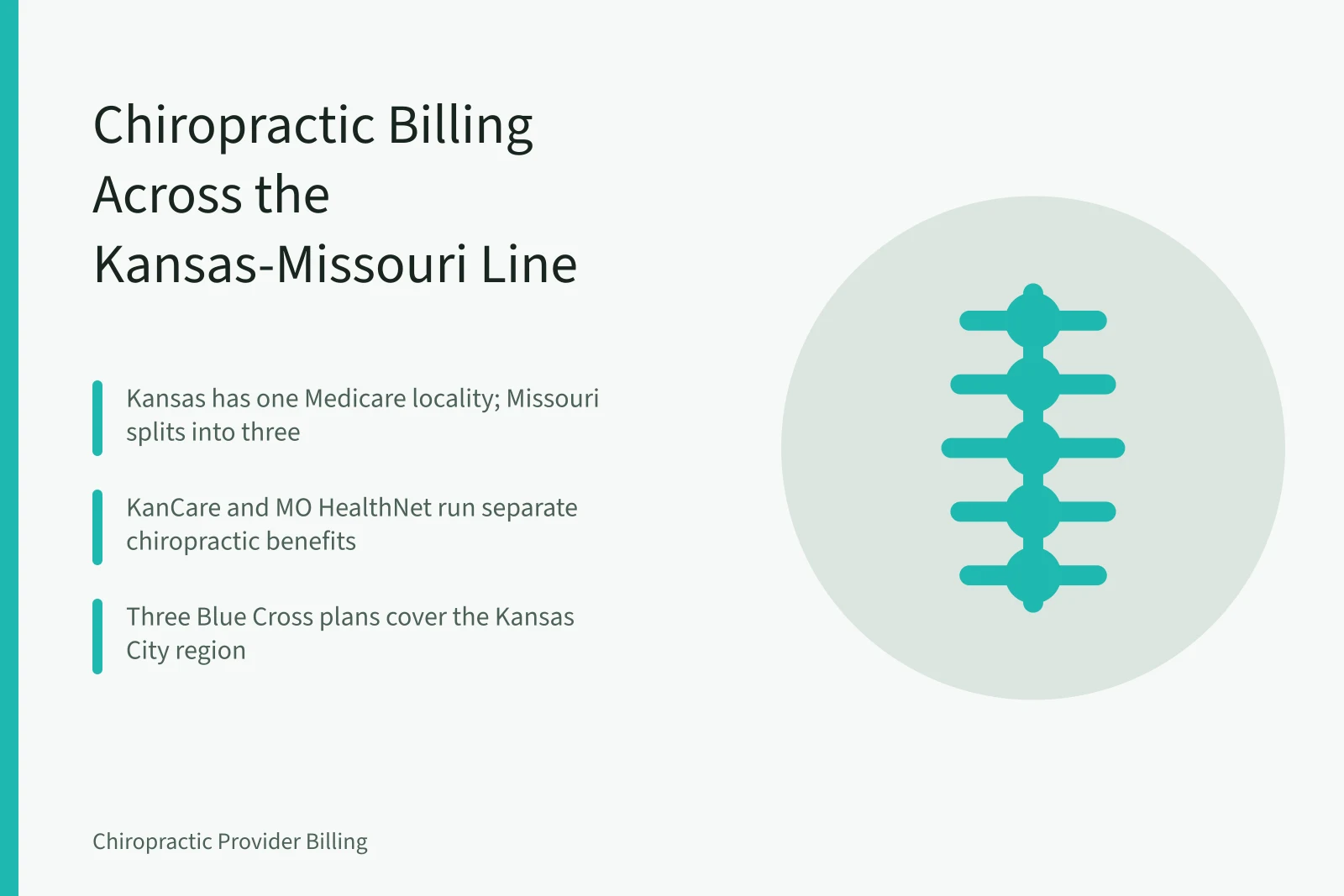
- Kansas runs a single statewide Medicare payment locality. Missouri splits into Kansas City, St. Louis, and a rest-of-state locality, so an identical CPT code pays a different allowed amount depending on the office address.
- KanCare and MO HealthNet are separate Medicaid programs, and both push most chiropractic benefits through managed care plans that set their own visit limits.
- Three Blue Cross plans cover the Kansas City regionBlue Cross and Blue Shield of Kansas, Blue Cross and Blue Shield of Kansas City, and Anthem Blue Cross and Blue Shield in Missouri.
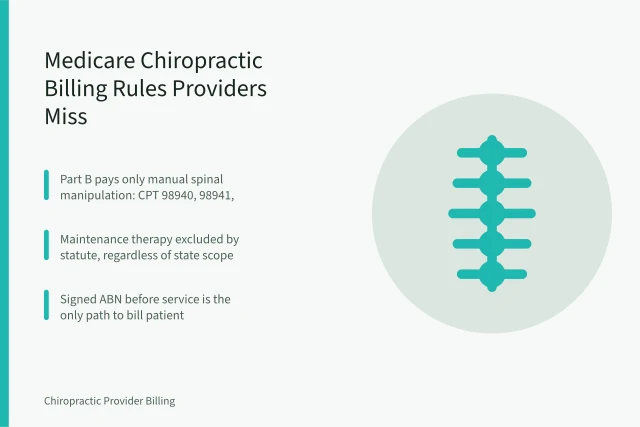
- Medicare pays only for manual manipulation of the spine to correct a subluxation, using codes 98940, 98941, and 98942 with the AT modifier. Maintenance care is not covered.
Two Medicaid programs with different chiropractic rules
KanCare is Kansas Medicaid. MO HealthNet is Missouri Medicaid. Neither state publishes one chiropractic fee that applies to every enrolled member. The practical detail is set out in Chiropractic Billing In-Network vs Out-of-Network Which.
Kansas places most beneficiaries in KanCare managed care organizations, which administer the chiropractic benefit and set their own authorization rules. Missouri uses a mix of managed care and fee-for-service depending on the population.
A Kansas chiropractor and a Missouri chiropractor can bill the same 98941 and be paid from two different fee schedules. Eligibility checks belong at the front desk, before the adjustment, not after the denial arrives.
Where Medicare splits at the state line
Medicare pays chiropractors from one national fee schedule, adjusted by geographic practice cost indices. Kansas has a single payment locality covering the whole state. Missouri has several, including Kansas City and St. Louis.
WPS Government Health Administrators processes these claims as the Medicare Administrative Contractor for Jurisdiction 5. One contractor, several localities, different allowed amounts.
Codes 98940 through 98942 describe spinal manipulation. Code 98943, extraspinal manipulation, is not a Medicare-covered chiropractic service. Claims need the AT modifier and a documented subluxation.
Example: one adjustment, four payer paths
One Adjustment, Four Payer Paths
Medicare KC
- Codes billed
- 98940-98942
- Confirm before claim
- AT modifier, ABN
BCBS KC
- Codes billed
- 98940-98943
- Confirm before claim
- Visit limit, network
KanCare MCO
- Codes billed
- 98940-98942
- Confirm before claim
- Eligibility, carve-in
MO HealthNet
- Codes billed
- 98940-98942
- Confirm before claim
- Eligibility, plan
One adjustment, four payer paths
Codes billed
- Medicare, Kansas City locality
- 98940 to 98942
- Blue Cross and Blue Shield of Kansas City
- 98940 to 98943
- KanCare managed care plan
- 98940 to 98942
- MO HealthNet
- 98940 to 98942
Confirm before the claim
- Medicare, Kansas City locality
- AT modifier, active treatment, ABN on file
- Blue Cross and Blue Shield of Kansas City
- Visit limit, network status, referral rules
- KanCare managed care plan
- Eligibility on the date of service, benefit carve-in
- MO HealthNet
- Participant eligibility, plan assignment
Blue Cross plans across the state line
Blue Cross and Blue Shield of Kansas City writes business on both sides of State Line Road. One contract can therefore cover patients in Missouri and Kansas.
Blue Cross and Blue Shield of Kansas serves members outside the Kansas City service area on the Kansas side. Anthem Blue Cross and Blue Shield handles most Missouri commercial Blue business.
Each plan keeps its own chiropractic fee schedule and medical policy. The codes you bill may match, while the allowed amount and the documentation standard often do not.
Rate gaps that shape Midwest payer mix
Commercial Blue rates in the Kansas City metro generally sit above Medicaid rates. Medicare sits between them in many offices, though not in every one.
The gap widens when a practice treats a high share of Medicaid members. KanCare and MO HealthNet rates are built from each state budget, not from the Medicare fee schedule.
Track two numbers per code: the allowed amount and the collection rate. A high allowed amount with a weak collection rate pays less than a modest fee collected in full.
Checking real rates before a claim goes out
Verify Before the Claim Goes Out
- Record CMS allowed amounts for 98940-98942
- Confirm Medicare Secondary Payer status
- Verify Medicaid eligibility on date of service
- Load commercial contracted fee schedules
Checking real rates
- Open the CMS Physician Fee Schedule lookup and select the patient's payment locality, then record the allowed amount for 98940, 98941, and 98942.
- Confirm Medicare Secondary Payer status when a patient has Medicare plus an employer plan, because the wrong primary payer produces a denial and a rebill.
- Verify Medicaid eligibility on the date of service, since KanCare and MO HealthNet terminate coverage when a member misses renewal.
- Load each commercial plan's contracted fee schedule into the billing system so expected reimbursement matches the claim.
A note on British Columbia
Canadian chiropractors bill a provincial plan rather than a set of commercial payers. The Medical Services Plan of British Columbia pays for medically required practitioner services under one provincial schedule.
That structure removes the payer mix question that Kansas and Missouri practices answer every day. It also means one fee schedule, one appeal route, and one set of billing rules.
Where the state split shows up in the claim
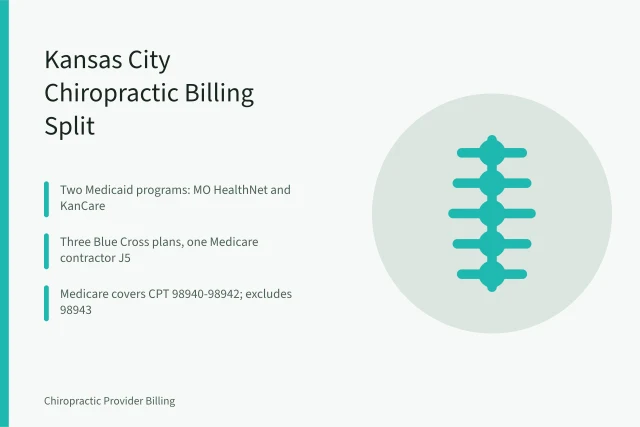
Kansas City practices bill across a state line, two Medicaid programs, three Blue Cross plans, and one Medicare contractor. The payer-by-payer split, including how the Medicare and Blue Cross rules differ, is covered in the BCBS and Medicare comparison.